
Review · WALKING TOURS
Prague Renaissance and Baroque Gardens Walking Tour
Prague’s grandest gardens tell a story of power, taste, and imported ideas. On this three-hour walk, you’ll move from Emperor Ferdinand I’s Italian-inspired Royal Gardens to Wallenstein’s theatrical Baroque grounds, then finish in the intimate Vrtba Garden above Malá Strana. The shift from Renaissance order to Baroque drama gives the tour a clear thread.
I like the unusual focus. Most first-time Prague walks stay on the Old Town streets, while this one explains how gardens shaped royal life, medicine, religion, and noble ambition. I also like the small details, from the bell-like Singing Fountain to the first figs, oranges, lemons, almonds, and tulips grown in Central Europe.
The main drawback is physical: you’ll tackle narrow and sometimes steep stairs, along with a fair amount of uphill and downhill walking. Garden admissions are not included in the $123 price, so the final cost is higher than the advertised tour fee.
Key details at a glance
- Italian Renaissance in Prague: Learn why Ferdinand I brought Italian gardeners and architects north of the Alps.
- The Singing Fountain: Hear how water drops make the 1564 bronze fountain resonate.
- Royal horticulture: Visit the Fig House and Orangery, linked with the early cultivation of Mediterranean fruits in Central Europe.
- Wallenstein’s theatrical garden: Look for albino peacocks, Mannerist statues, fountains, and a grotto wall.
- Vrtba Garden’s city views: Climb through a Baroque walled garden to a top courtyard with a marine-themed grotto.
- A stair-heavy route: Choose a private tour if you need the guide to adjust the pace or skip difficult sections.
Why Prague’s gardens make a good history walk
A garden can tell you what a society valued. Medieval gardens around Prague were mostly practical places for growing herbs used in cooking and medicine. Some survive in Gothic cloisters, while vineyards on the hills recall an even older tradition.
The grand palace garden arrived later. In the 1500s, Emperor Ferdinand I wanted Prague to match the refined Italian courts he admired. He brought Italian architects and gardeners to Bohemia, introducing formal design, classical sculpture, exotic plants, and carefully planned pleasure grounds.
That background makes the tour more than a stroll among flowers. You’ll see how royal gardens became places for ceremony, private leisure, scientific experiments, and political display. A fountain was not simply a fountain. A citrus tree was not just a citrus tree. Each showed money, access, and connections far beyond Prague.
The historian guide is central to the experience. The tour is offered in English, and guides named Miriam and Bonita Rhoads have been associated with especially strong experiences. Miriam, in particular, was praised for an informative but relaxed manner. That balance matters here because the route includes many names, dates, and design terms. A good guide keeps the story moving instead of turning the walk into a lecture.
More Garden Walks in the world:
- Marrakech: Ben Youssef, Secret Garden, & Souks Walking Tour
★ 4.6 · 2,802 reviews - Sintra & Cascais Day Tour with Pena Palace Entry and Gardens Walk
★ 5.0 · 962 reviews - Versailles Château and Gardens Walking Tour
★ 4.5 · 727 reviews
Starting at Prague Castle’s Royal Gardens
The route begins at the door of Bagel Lounge Malostranska, then heads toward the gardens below Prague Castle. You’ll hear how Ferdinand I commissioned a grand royal garden influenced by Renaissance Italy, a major change from the smaller herb plots and vineyards that came before.
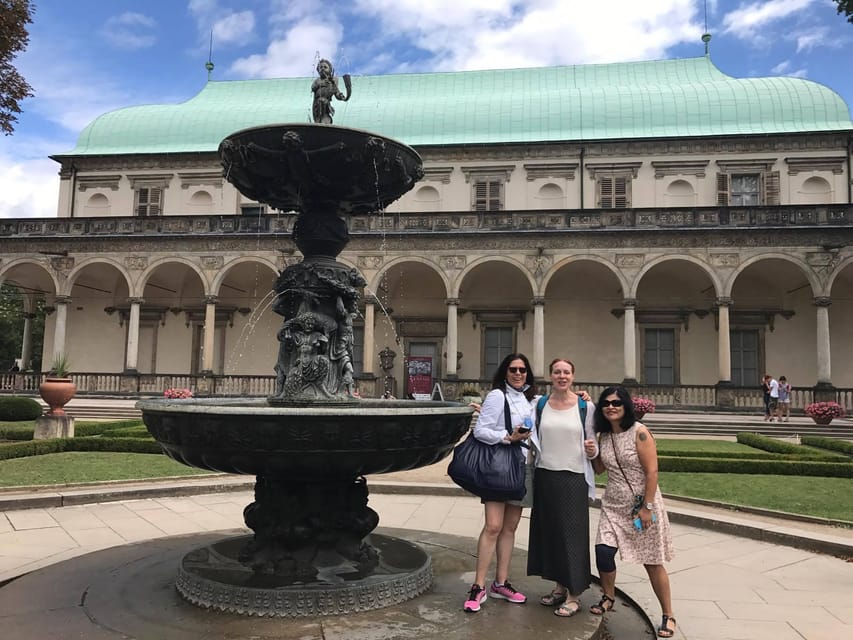
The first major sight is the Belvedere Summer Palace, also called Queen Anne’s Summer Palace. Ferdinand commissioned it as a gift for his wife, Queen Anne, though she died before the building was finished. That sad detail gives the elegant structure a more personal story.
The palace was designed by the Italian architect Paola della Stella. It is often described as the finest Renaissance building outside Italy, a bold claim, but its Italian character is easy to understand when you compare it with the heavier medieval buildings nearby.
Look closely at the reliefs. One shows Ferdinand presenting his wife with a flower from the Royal Gardens. It is the sort of small image that makes the imperial story feel human. This was not only a palace project. It was also a carefully staged expression of affection, taste, and status.
In front of the Belvedere is a small formal garden, or giardinetto, with the famous Singing Fountain. Cast in bell bronze in 1564, the fountain produces a resonant sound when water drops strike the bowl. You may not hear a full musical performance in the modern sense, but the design reflects Renaissance fascination with mechanics, sound, and controlled nature.
I find this opening section especially useful for setting expectations. You are not simply looking at attractive plants. You are seeing the arrival of a new courtly style in Prague, one that reached north from Italy and changed how rulers presented themselves.
Fig House, Orangery, and the first exotic plants
The walk continues to the Fig House and Orangery. These structures helped grow plants that were not suited to Central Europe’s climate, including figs, almonds, oranges, and lemons.
The exact plants on display can vary, but the historical point is clear. Growing Mediterranean fruit in Prague required buildings, careful heating, skilled gardeners, and access to rare specimens. These were expensive experiments, not ordinary kitchen gardening.
This is also where the tour connects architecture with food and science. A royal orangery was both a working greenhouse and a symbol of wealth. The court could display fruit that did not naturally grow in the region, then serve it as a sign of reach and refinement.
You’ll also hear about tulips, which were introduced to the Royal Gardens as an exotic gift from the Sultan of Constantinople. In the sixteenth century, a flower could travel as carefully as a diplomatic letter. The tulip story gives you a useful reminder that gardens have always been connected to trade, empire, and cultural exchange.
The gardens near Prague Castle are broad enough to offer a change of pace after the architectural detail around the Belvedere. Still, you should not expect a long free period to sit and garden-watch. The tour covers several sites in three hours, so the guide’s explanations remain the focus.
From the Stag Moat to the Castle’s South Gardens
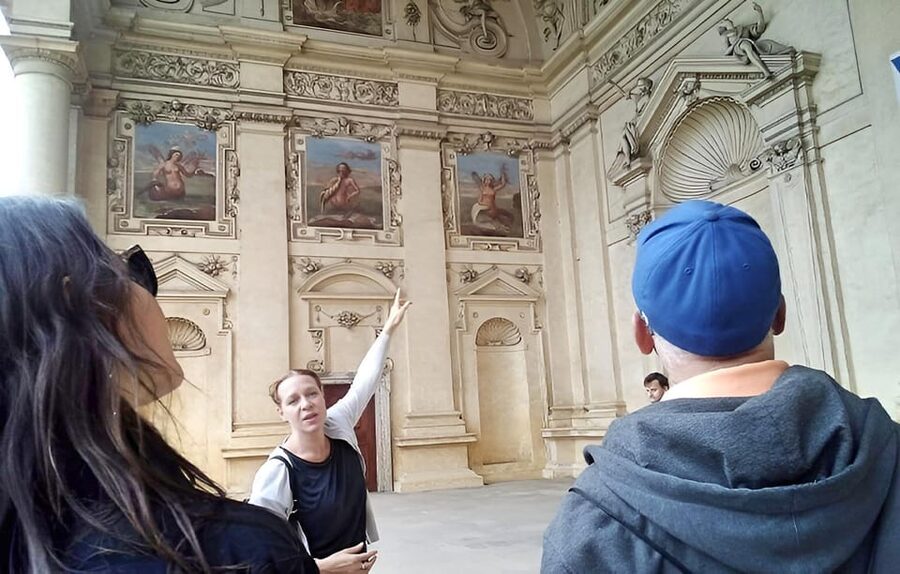
Near the western end of the Royal Gardens, you’ll see the stag moat before crossing through a castle courtyard. The route then descends the Bull Stairs toward the South Gardens.
This transition is one of the tour’s more physical sections. The stairs can be narrow or steep, and the route includes both descents and later climbs. Wear shoes with a secure grip, and do not choose this walk if you want a flat, easy outing.
The South Gardens include the Garden of Paradise and the Garden on the Bulwark. Their names hint at the way royal gardens borrowed from religious and symbolic ideas. A paradise garden suggested order, protection, and an ideal world, while a garden on a defensive structure connected beauty with the castle’s military setting.
From the South Gardens, you’ll make your way down through several terraced gardens beneath the castle. The terraces are important because they show how designers used Prague’s hillside rather than trying to hide it. Levels, retaining walls, stairs, and framed views turn a steep site into a sequence of rooms.
This section may appeal most to anyone who likes urban design. You’ll see how gardens can link a fortress above with noble quarters below. The route also gives you a changing view of Prague as you descend, though the strongest panorama comes later at Vrtba Garden.
A few more garden visits around the world worth a look
- Paris: Versailles Palace and Gardens Full Access Ticket
★ 4.6 · 41,579 reviews - Versailles: Skip-the-Line Tour of Palace and Gardens Access
★ 4.7 · 10,429 reviews - Marrakesh: Majorelle Garden Entry Tickets
★ 4.5 · 9,651 reviews - Vienna: Schönbrunn Palace & Gardens Skip-the-Line Tour
★ 4.7 · 7,739 reviews
Wallenstein Garden and the drama of Baroque style
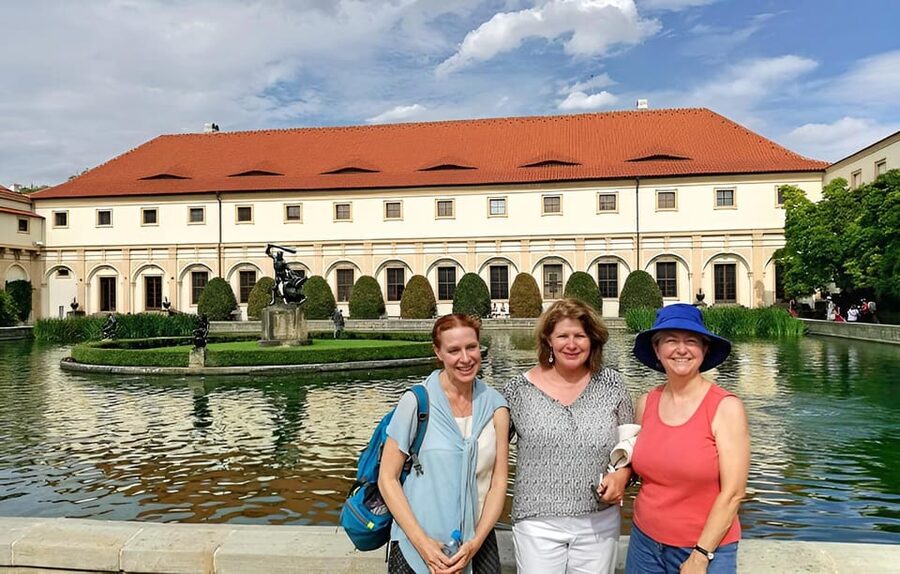
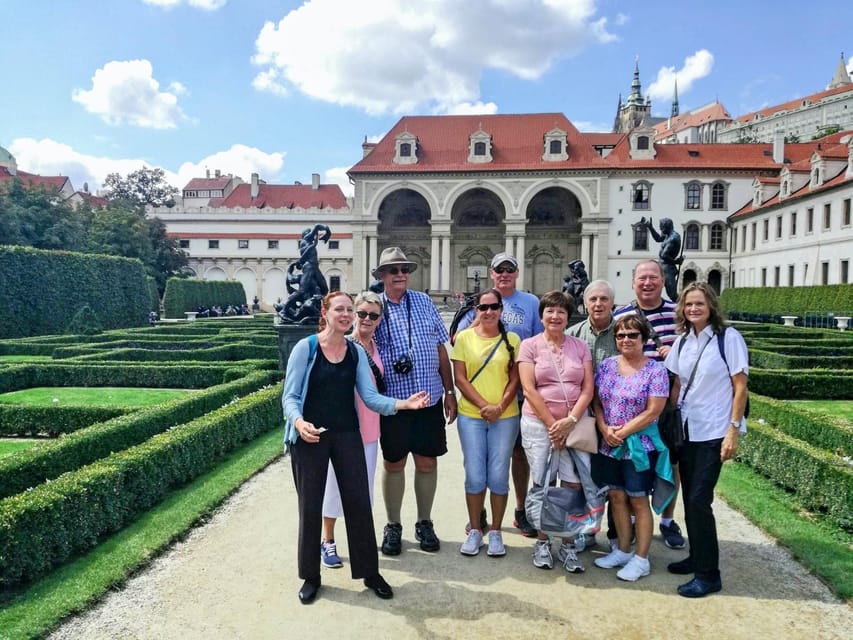
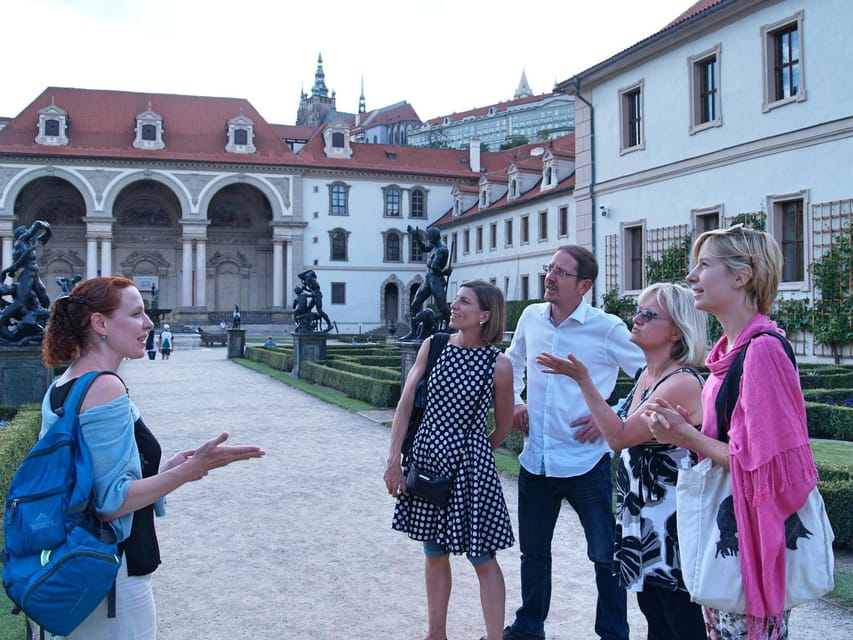
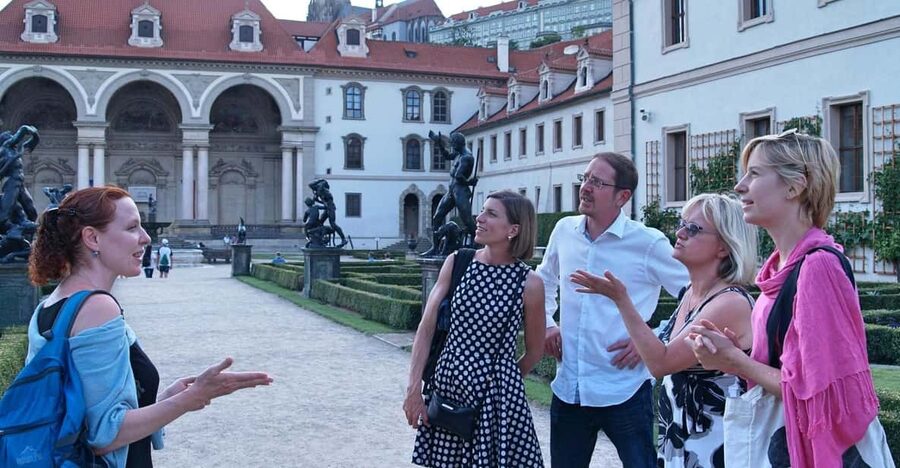
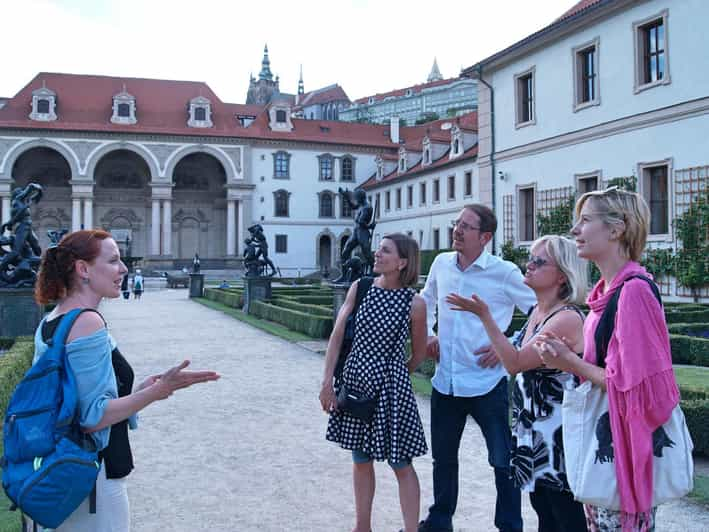
At the bottom of the hill, the mood changes sharply at Wallenstein Garden. The garden is grander, more theatrical, and more openly ambitious than the royal terraces above.
Its commissioner was Albrecht von Wallenstein, a powerful military leader whose career was as dramatic as the garden itself. The guide explains how the garden reflects the shift from Renaissance classicism to Baroque thinking. Renaissance design favored measured order and classical balance. Baroque design pushed toward surprise, motion, spectacle, and emotional effect.
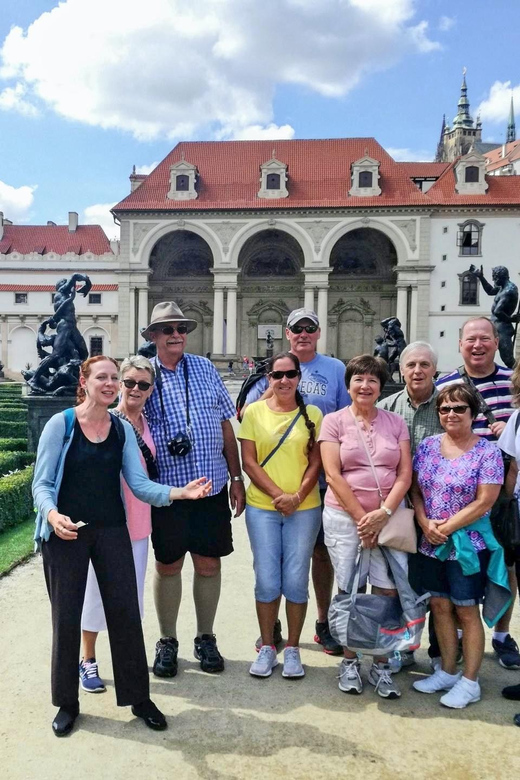
Wallenstein Garden makes that change easy to see. You’ll encounter Mannerist statues, mythical fountains, a grotto wall, and albino peacocks. The pale birds are an especially memorable touch, though their presence and visibility can vary.
The grotto wall is designed to look irregular and slightly wild, a contrast to the formal geometry elsewhere. Mythical figures and fountains add movement and fantasy. Instead of presenting nature as perfectly controlled, the Baroque garden creates a staged world where artifice and drama are part of the pleasure.
I like this stop because it gives you something to compare. The Belvedere and Royal Gardens introduced a classical Italian ideal. Wallenstein Garden takes that language and makes it louder. The two sites are not just separate attractions. Together, they show changing ideas about how a ruler should impress an audience.
The limitation is time. Wallenstein Garden contains enough detail for a longer visit, but the tour must keep moving to reach Vrtba Garden. If you like to photograph every statue or sit quietly beside each fountain, you may wish for more freedom than a guided three-hour route allows.
Vrtba Garden, Prague’s intimate Baroque surprise
The final garden is Vrtba Garden in Malá Strana, a Baroque walled garden dating from 1720. It feels more enclosed and personal than the royal grounds and Wallenstein Garden.
Vrtba was created for noble life in the eighteenth century. Its design shows how a private garden could be arranged as a series of terraces on a tight hillside site. The walls make the garden feel separate from the city, even though Prague is close on every side.
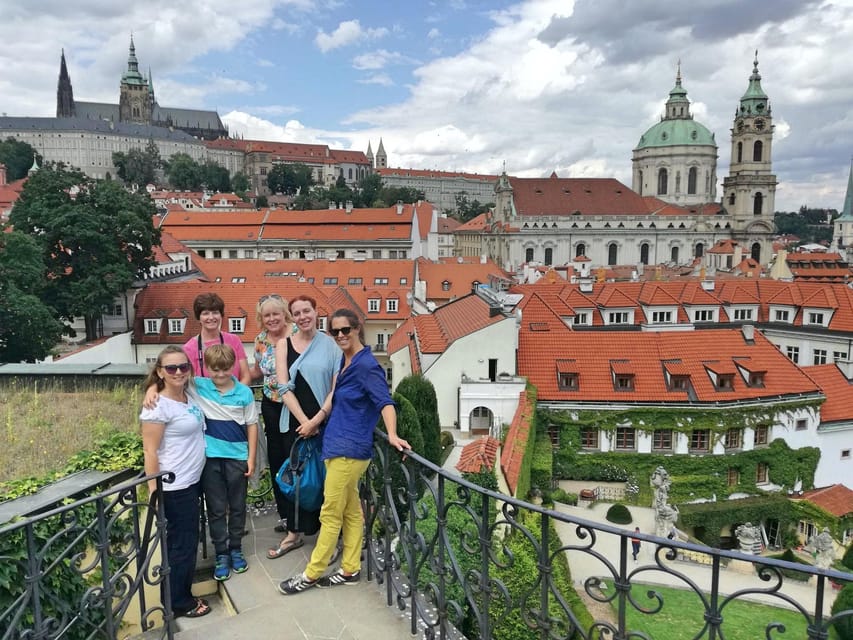
As you climb, the garden becomes more rewarding. The upper courtyard contains a marine-themed grotto, adding a playful fantasy element to the formal design. At the top, you receive broad views across Prague’s cityscape.
That final climb is worth noting. It involves stairs, but it also gives the tour a natural finish. You move from the practical plants of the Royal Gardens, through imperial ceremony and Wallenstein’s public grandeur, to a private noble garden that ends with a view over the city.
Vrtba is also the least obvious stop for many people planning a Prague visit. It does not have the fame of the castle, Charles Bridge, or Old Town Square, yet it offers a direct look at eighteenth-century noble taste. If you have already seen Prague’s main monuments, this garden adds a quieter and more specialized side of the city.
Admission to Vrtba Garden is extra. The gardens under Prague Castle also require a separate admission fee, so check the current costs when planning your budget.
What the $123 price really covers
At $123 per person, this is not a bargain-priced garden walk. The fee pays for a three-hour guided history experience with a historian guide, but it does not cover garden admissions.
The value depends on how much context you want. If you only need directions and a quick look at the fountains, you can visit some of these places independently for less. If you want the connections between Italian Renaissance design, Habsburg ambition, greenhouse cultivation, Wallenstein’s political story, and Baroque garden theory, the guide adds real value.
The price also makes more sense for a private or small group booking, where the guide can spend more time on your questions. A standard group may be better for keeping costs manageable, but the exact group size is not stated, so ask before booking if personal attention matters to you.
Free cancellation is available up to 24 hours in advance, and you can reserve without paying immediately. Those terms help if your Prague schedule is still shifting, but they do not change the extra admission charges.
Who should book this garden walk
I would recommend this tour to you if you enjoy architecture, royal stories, horticulture, sculpture, or the way cities reveal their past through design. It is also a good choice if you have already seen Prague’s headline sights and want something more specialized.
The tour suits adults and older children who can manage stairs. It may be less suitable for anyone with mobility limits, knee problems, or a strong preference for level paths. The regular route includes narrow and steep stairs, so a private tour is the sensible choice if you need a slower rhythm or want to leave out certain sites.
Bring comfortable shoes and allow energy for hills. The route is only three hours, but the terrain makes it more demanding than a flat city-center walk.
Should you book it?

Book this tour if you want Prague’s gardens explained rather than simply photographed. The mix is unusually strong: Ferdinand I’s Italian vision, a fountain that sings, early citrus cultivation, tulip diplomacy, Wallenstein’s theatrical grounds, and Vrtba’s final city view.
Skip it if you want a relaxed garden visit with long pauses, or if the admission fees and steep stairs are likely to outweigh the appeal. For most architecture and history fans who can handle the route, the tour offers a focused look at a side of Prague that many sightseeing plans miss.
FAQ
How long does the Prague Renaissance and Baroque Gardens Walking Tour last?
The tour lasts three hours.
What language is the tour offered in?
The tour is offered in English with a live guide.
Where is the meeting point?
Meet at the door of Bagel Lounge Malostranska.
Are garden admission fees included?
No. Admission to the gardens under Prague Castle and admission to Vrtba Garden are not included.
Is the tour suitable for people with mobility issues?
The regular route includes narrow and sometimes steep stairs, plus walking uphill and downhill. If you have mobility concerns, a private tour may allow the guide to adjust the route, pace, and number of sites.
Is a private tour available?
Yes. Private and small-group options are available.
Can I cancel the tour for a refund?
Yes. You can cancel up to 24 hours in advance for a full refund. You can also reserve now and pay later.
Just added around the world
- Skip-the-Line Guided Tour and Gardens Entry in Versailles Palace★ 3.5 · 3 reviews
- Versailles Palace Guided Experience and Gardens Entry 10 PPL Max★ 5.0 · 42 reviews
- Versailles Palace & Gardens Audio Tour – Private Transportation★ 4.5 · 11 reviews
- Versailles Palace and Gardens Tour★ 4.5 · 44 reviews
- Versailles: Farmers Market & Royal Vegetable Garden Food Tour★ 5.0 · 11 reviews
- Versailles Gardens Walking Tour with Audioguide (no tickets)★ 3.0 · 6 reviews
- Versailles Golf Cart & Shuttle Guided Tour, Hamlet and Gardens★ 4.5 · 13 reviews
- Palace of Versailles Entry ticket with Musical Gardens & Estate★ 3.5 · 55 reviews
Walking Tours, compared.

Ben Youssef, Secret Garden, & Souks Walking Tour
Read our review →
Sintra & Cascais Day Tour with Pena Palace Entry and Gardens Walk
Read our review →
Giverny Village Walking Tour & Skip-the-Line to Monet Garden
Read our review →
Imperial Palace East Garden and Edo Castle Walking Tour in Tokyo
Read our review →
Salzburg: Old Town, Mozart, & Mirabell Gardens Walking Tour
Read our review →
Kyoto Arashiyama Bamboo forest & Garden Half-Day Walking Tour
Read our review →Browse the lists this tour appears in