
Review · GRANADA
Granada: 3-Hour Alhambra and Generalife Gardens Guided Tour
The Alhambra is not just one palace. It is a hilltop complex of royal rooms, defensive walls, courtyards, gardens, and views across Granada. This three-hour guided visit gives you the key pieces in a sensible order, with the Court of the Lions, Hall of the Ambassadors, Nasrid Palaces, and Generalife Gardens at the center.
I like the clear audio system, which lets you hear the guide without pressing shoulder to shoulder in every room. I also like the guides’ mix of history, symbolism, humor, and practical help. Carlos, José, Veronica, and Yolanda are especially praised for making the details easy to follow. The main drawback is that your selected time is provisional, since the Alhambra assigns entry to the Nasrid Palaces according to capacity.
Key points
- The Nasrid Palaces are the star: See Mexuar, Comares, and Leones, including the Court of the Lions and Hall of the Ambassadors.
- The Generalife completes the visit: Walk through the sultans’ summer palace and gardens after the formal palace interiors.
- Guides add meaning: Carlos, José, Veronica, and Yolanda are noted for clear explanations, humor, local insight, and good pacing.
- The audio equipment works well: You can hear commentary even when the group spreads out in crowded rooms.
- The timing needs flexibility: The Alhambra may confirm your exact Nasrid Palace entry time as late as the day before.
- Expect a lot of walking: The complex is large, and comfortable shoes and water will make the three hours easier.
Why this Alhambra tour is worth three hours

The Alhambra can be confusing on your own. It is easy to admire the tiles and carved plaster without understanding how the rooms worked, who used them, or why certain inscriptions appear again and again.
A good guide gives the decoration a purpose. You hear how the Nasrid rulers used courtyards, fountains, light, geometry, Arabic writing, and carefully framed views to create a royal setting. You also get the political and religious background that helps explain the final Muslim dynasty of Granada before the Christian conquest in 1492.
At $88 per person, this is not the cheapest way into the monument. But the price includes admission to the Alhambra complex, the Nasrid Palaces, and Generalife Gardens, along with a professional bilingual guide and audio equipment. Since tickets are limited and the site is easy to mishandle without a plan, the fee can be fair for visitors who want structure and context.
If you already have a deep interest in Islamic architecture and prefer to read every room at your own pace, you may find a self-guided visit more flexible. For most first-time visitors, though, the guide helps you notice details you would likely walk past.
More Palace and Castle Gardens in Spain
- Granada: Alhambra & Gardens Tour w/Nasrid Palaces Option
★ 4.2 · 7,022 reviews - Granada: Alhambra Guided Tour with Nasrid Palaces & Gardens
★ 4.7 · 2,190 reviews - Alhambra &Charles Palace Guided Tour with Optional Nasrid Palaces
★ 4.5 · 2,149 reviews
Meeting at the Alhambra ticket plaza

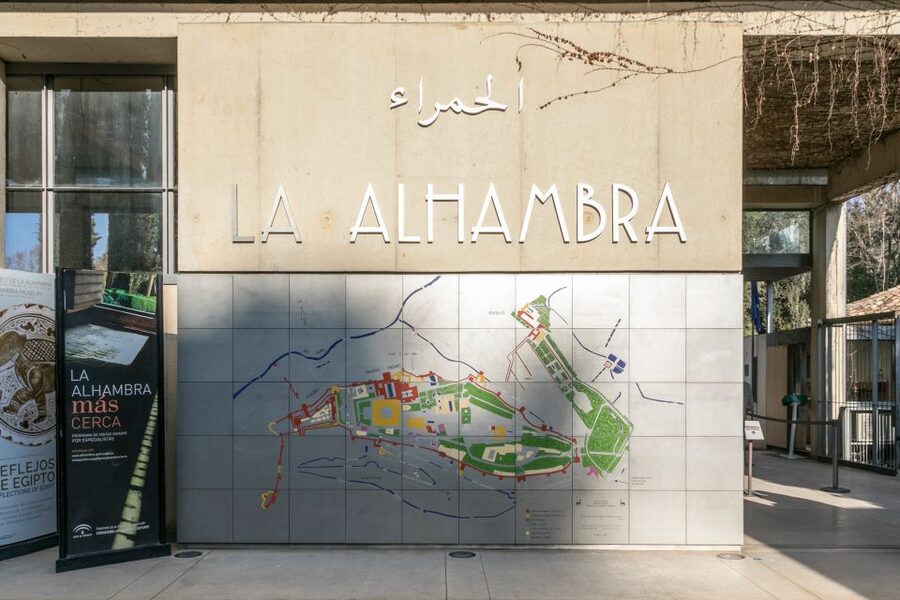
You meet in the square by the monument’s ticket offices. Look for the small sign with a blue dot marked guides. The meeting point is not in central Granada, and the ticket-office area can feel confusing when several groups gather at once, so arrive with time to spare.
The activity does not include hotel pickup or drop-off. You need to make your own way to the Alhambra and bring the original passport or identity card used during booking. Tickets are nominative, meaning the name and ID details must match the participant entering the site.
Large bags and luggage are not allowed, and smoking is prohibited. Bring a reusable water bottle. You will be outdoors for parts of the visit, and the complex involves plenty of walking between courtyards, palaces, and gardens.
The audio system is one of the tour’s most useful practical features. In a crowded courtyard, you can step aside for a photograph and still follow the guide’s explanation. Several guides also make time for questions and photographs instead of talking nonstop while the group hurries past.
The Alhambra complex and its first impressions
The Alhambra began as a fortress and royal city for the Nasrid sultans. Its name is linked to the reddish color of the hilltop walls, though what you see today is a mixture of military buildings, palaces, gardens, later Christian additions, and restored interiors.
The first part of the visit may include exterior areas and the Palace of Charles V, depending on the guide’s route and the timing of the Nasrid Palace entry. The circular courtyard of Charles V’s Renaissance palace creates a sharp contrast with the Islamic buildings nearby. It is a useful visual lesson: the Alhambra is not a single untouched monument but a place shaped by several periods.
From the higher parts of the complex, you get broad views over Granada and toward the surrounding hills. The views are not a minor extra. They help you understand why the site was chosen and how the palace looked over the city it ruled.
The grounds can be busy, especially around narrow entrances and smaller rooms. The Alhambra controls visitor numbers, but it is still a major attraction. A skilled guide may alter the order, pause in a less crowded area, or return to a room later when the flow improves.
The Nasrid Palaces: Mexuar, Comares, and Leones

The Nasrid Palaces contain the most delicate work on the site. This is where the tour slows down and the guide’s commentary earns its keep.
More Palace and Castle Gardens in Granada:
- Granada: Alhambra and Generalife Garden Ticket & Guided Tour
★ 4.0 · 1,862 reviews - Granada Alhambra and Generalife Gardens Experience Tour
★ 4.2 · 639 reviews - Granada: Alhambra and Generalife Gardens Guided Tour
★ 4.5 · 510 reviews - Alhambra Experience – Explore Nasrid Palaces & Generalife Gardens
★ 3.5 · 363 reviews
Mexuar
The Mexuar served administrative and official functions. It is less about private royal life and more about business, judgment, and government. Look closely at the repeated patterns, tiled walls, carved surfaces, and inscriptions. The decoration is not random ornament. Geometry and writing helped create an atmosphere of order and authority.
Your guide can also explain how later changes affected the rooms. This matters because the Alhambra’s history is not frozen at one moment. Christian rulers adapted parts of the complex, and centuries of restoration have shaped what you see today.
Comares Palace
Comares is the formal heart of the Nasrid Palaces. Its rooms and courtyards were designed to impress, but the effect is not loud or heavy. Water, proportion, reflection, and controlled views do much of the work.
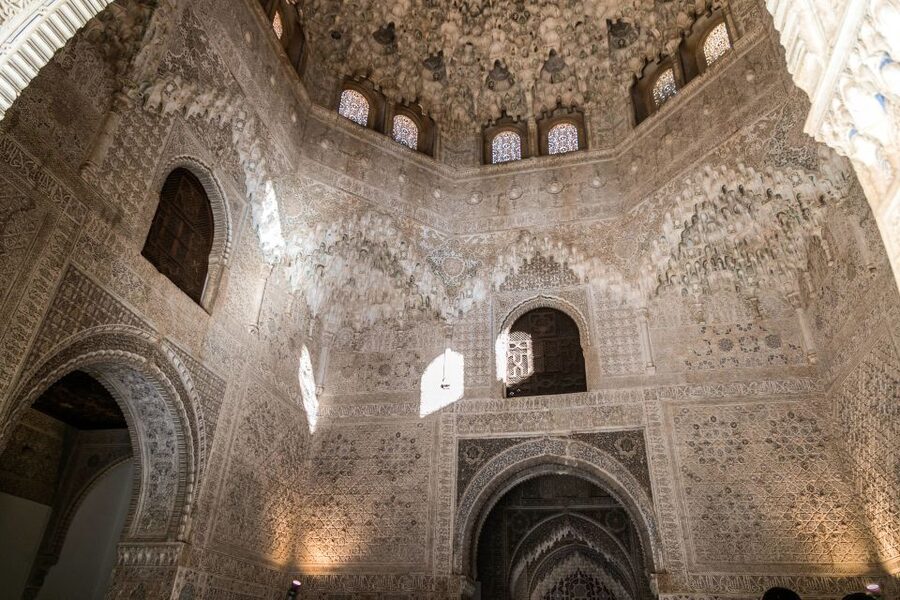
The Hall of the Ambassadors is one of the major stops. It was used for formal receptions and is among the grandest interiors in the complex. The room’s height, decoration, and carefully arranged surfaces show how architecture could turn a political meeting into theater.
This is the kind of place where a guide’s explanation changes the visit. Without context, you see an extraordinary room. With context, you begin to understand how its scale and decoration communicated power.
Palace of the Lions
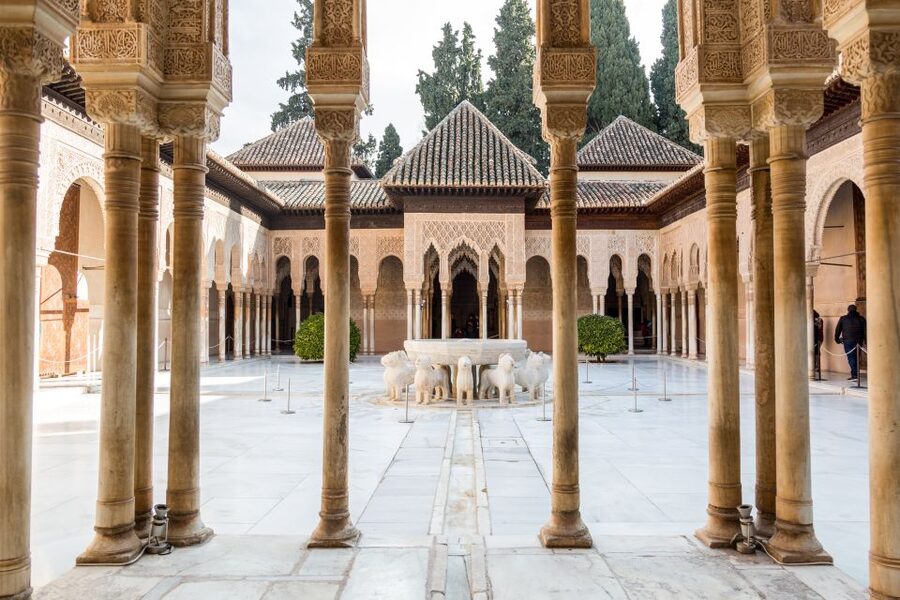
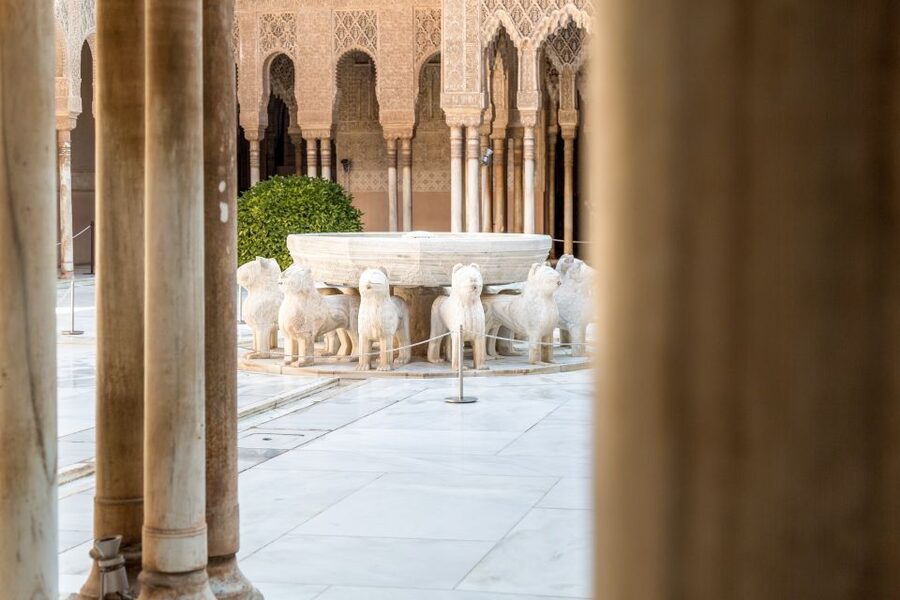
The Court of the Lions is the Alhambra image most people know, and it deserves its fame. Slender marble columns surround the central fountain, while blue and yellow tilework and fine plaster decoration cover the surrounding spaces.
The fountain is also an engineering achievement. Water moves through the court and connects the visual beauty to the practical design of the palace. Your guide may point out the relationship between the fountain, the surrounding rooms, and the way the courtyard brings light and air into the building.
The small rooms around the court can become crowded. You may need patience while groups move through, and there may not be much room to stop for long. The audio equipment helps, but it cannot create space where there is none. You will get time for photographs, though the pace remains controlled because the group must stay on schedule.
Arabic inscriptions, symbols, and the Moorish past
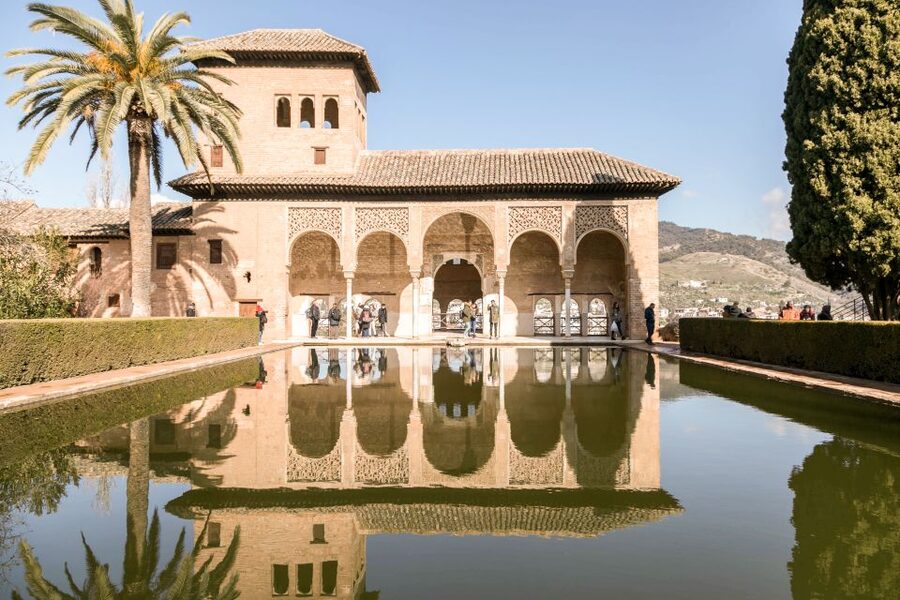
The Alhambra is especially rewarding if you want to understand Islamic art beyond surface decoration. Arabic inscriptions appear throughout the palaces, including repeated references to God, poetry, blessings, and royal authority.
The exact meaning and symbolism can be hard to grasp from a guidebook alone. A guide can point out how writing works alongside tile, plaster, water, and architecture. This gives you a better sense of the palace as a complete artistic system rather than a collection of pretty walls.
The tour also places the buildings in Granada’s Moorish past. You learn about the Nasrid Dynasty, the final Muslim ruling house in Iberia, and the society that created this courtly world. The historical and religious context is handled by the guide in real time, so you can ask about details that catch your attention.
Guides vary in personality, but the strongest examples here include José’s story-based delivery, Carlos’s clear historical explanations and humor, Veronica’s attention to symbolism and photography, and Yolanda’s long experience and passion for the site. The languages offered are English, Spanish, and French. Commentary may sometimes be given in two languages, so some sections can take longer.
Generalife Gardens and the end of the route
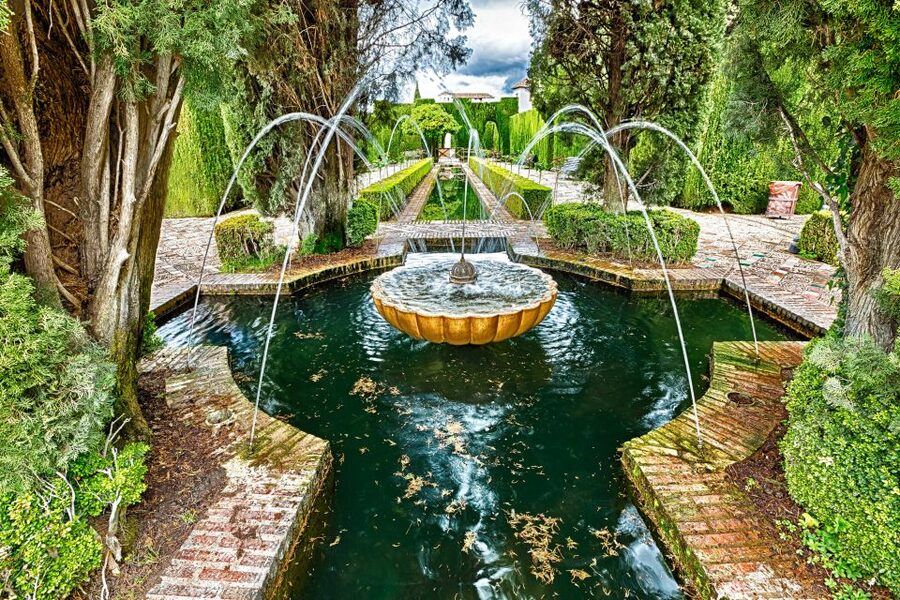
The Generalife was the sultans’ summer palace and retreat. Its gardens offer a change of mood after the decorated interiors of the Nasrid Palaces.
Here, water and planting take the lead. Long pools, fountains, paths, and terraces create cool, orderly spaces with views back toward the Alhambra. The gardens are not simply a pleasant finish. They show another side of royal life, built around rest, shade, sound, and outlooks rather than formal audiences.
You may have time to stop for photographs and take in the views. Some people find the gardens more relaxed than the palace rooms, while others prefer the indoor decoration. Either way, including Generalife makes the visit feel more complete.
The route can be tiring. One 75-year-old visitor found the three hours exhausting but still worthwhile, and that is a fair warning. The complex covers a large area, with standing and walking throughout. A wheelchair user was accommodated with alternative routes and assistance, but accessibility needs should be raised with the provider before booking because the exact route can depend on conditions and crowd flow.
Timing, crowd levels, and the provisional entry hour
This is the most important booking detail. The time you select is provisional because the Nasrid Palaces admit a limited number of people at each entry period. The Alhambra may confirm your exact time the day before the tour, and it could be in the morning, afternoon, or evening.
You should not schedule a train, flight, long day trip, or another fixed activity on the same day. The selected hour can change, and the Alhambra does not permit changes or refunds once tickets are assigned.
An afternoon slot may be quieter at some times, but no schedule guarantees empty rooms. The site is popular, and narrow palace interiors can feel crowded. A flexible attitude helps. The guide may move around a busy section and return later, which is a useful way to protect both the explanation and your chance to see the architecture.
The booking system can confirm tickets less than 45 days before the visit. If availability cannot be confirmed, the reservation is canceled and the full amount is refunded. If you cancel yourself, cancellation up to 24 hours ahead receives a 50 percent refund.
Is $88 a fair price?

I would call the price reasonable for a first visit, especially if you value explanation and want the main monuments handled in one route. You are paying for the admission, a three-hour official guided visit, audio equipment, and access to the Nasrid Palaces and Generalife Gardens.
The value is strongest for:
- First-time visitors to Granada
- People who want the Moorish, religious, and political background explained
- Anyone concerned about missing the most important rooms
- Families and mixed-age groups that benefit from a steady pace
- Visitors who prefer asking questions instead of reading every sign
- People who want help finding good photograph locations
The price may feel less attractive if you dislike organized groups or want to linger at every courtyard. The tour gives you time for photographs, but it cannot offer unlimited time in each room.
Who should book this Alhambra tour?
Book it if the Alhambra is a major reason for your visit and you want the site to make sense, not just look beautiful. The guide-led format is particularly useful for understanding the Court of the Lions, Hall of the Ambassadors, Arabic inscriptions, and the relationship between the palaces and gardens.
It also suits visitors who want a manageable three-hour introduction before exploring more on their own. One sensible approach is to take the guided route first, then revisit favorite areas if your ticket and schedule allow.
You may prefer another option if you need a fixed entry hour, cannot adapt to a last-minute time assignment, or strongly prefer complete independence. The tour also demands moderate stamina, so consider your walking needs before booking.
FAQ
How long is the Alhambra guided tour?
The guided visit lasts three hours. It covers the Alhambra complex, the Nasrid Palaces, and the Generalife Gardens.
What does the $88 price include?
The price includes entry tickets to the Alhambra Palace complex, the Nasrid Palaces, and Generalife Gardens. It also includes a professional bilingual guide and an audio system.
Which languages are available?
Guiding is available in English, Spanish, and French. Commentary may sometimes be given in two languages.
Where do I meet the guide?
Meet in the square by the Alhambra’s ticket offices. Look for the small blue-dot sign marked guides.
Is the selected tour time final?
No. The selected time is provisional because the Nasrid Palaces have limited capacity. The Alhambra may assign the exact entry time as late as the day before the tour and may place it in the morning, afternoon, or evening.
What identification should I bring?
Bring the original passport or identity card for every participant. Tickets are issued in each person’s name, and the ID details must match the booking.
Can I bring luggage or a large bag?
No. Luggage and large bags are not allowed. A reusable water bottle is recommended, and smoking is prohibited.
What happens if tickets cannot be confirmed?
If you book less than 45 days before the visit and the Alhambra cannot confirm availability, the reservation will be canceled and you will receive a full refund.
More 3-Hour Experiences in Granada
- Entebbe Walking Tour (3 Hours) with Zoo and Botanical Gardens Options
★ 4.5 · 36 reviews - Super Raft – Private Charter Maui 3 Hour Snorkel to Coral Gardens or Molokini
★ 5.0 · 21 reviews - 3-Hour Shanghai Yu Garden &Old Town Private Tour with Tea Tasting
★ 5.0 · 17 reviews - Taormina and Giardini Naxos – 3 Hour Boat Excursion
★ 5.0 · 16 reviews
Just added around Granada
- Tickets included: Alhambra (Gardens)★ 4.5 · 8 reviews
- Motril Skip-the-Line Shore Excursion:Alhambra, Generalife Gardens★ 4.5 · 6 reviews
- Alhambra Gardens, Generalife and Alcazaba Tickets & Local Guide★ 3.5 · 5 reviews
- Generalife, Gardens and Alcazaba guided tour (without Nasrid Palaces)★ 3.5 · 3 reviews
- Alhambra Tour :Generalife Gardens ,Palaces and towers.Skiptheline★ 5.0 · 7 reviews
- Granada, Visit Alhambra with Nasrid palaces, gardens and Alcazaba★ 5.0 · 17 reviews
- Guided tour of the Alhambra: Generalife and its gardens★ 4.0 · 9 reviews
- 2-Hour Guided Tour of Alhambra Gardens and Alcazaba in Granada★ 5.0 · 8 reviews
Granada Garden Tours, compared.

Alhambra & Gardens Tour w/Nasrid Palaces Option
Read our review →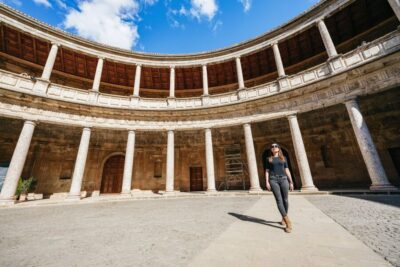
Alhambra Guided Tour with Nasrid Palaces & Gardens
Read our review →
Alhambra &Charles Palace Guided Tour with Optional Nasrid Palaces
Read our review →
Alhambra and Generalife Garden Ticket & Guided Tour
Read our review →
Flamenco Show in Albayzín – Jardines de Zoraya
Read our review →
Granada Alhambra and Generalife Gardens Experience Tour
Read our review →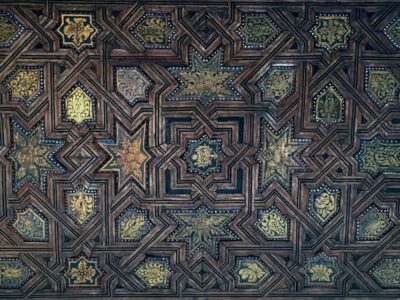

Alhambra Experience – Explore Nasrid Palaces & Generalife Gardens
Read our review →Browse the lists this tour appears in