
Review · USA
Dallas Arboretum and Botanical Gardens Tour
The best part of this private Dallas Arboretum tour is the chance to see a huge 66-acre garden without figuring out the paths yourself. Your guide can explain why certain plants thrive in North Texas, point out the garden’s water features and historic homes, and keep the visit focused on your group.
I like the round-trip SUV transport and the chance to see such different spaces in one visit, from the cool Palmer Fern Dell to the open views over White Rock Lake. The main drawback is pace: with roughly 15 minutes assigned to each stop, you’ll see a great deal, but you may not have time to linger at every garden.
Key points to know before booking
- Private guiding: Only your group takes part, so the visit can feel more personal than a standard garden walk.
- 66 acres to cover: The route includes major gardens, fountains, historic buildings, research plots, and scenic overlooks.
- Admission included: You do not need to arrange a separate garden entrance ticket.
- Pickup has limits: Hotel pickup is offered in central Dallas, though the stated pickup radius varies between two and three miles.
- Season matters: Spring flowers, October roses, winter crape myrtles, and summer shade each offer a different reason to visit.
- The price buys convenience: At $215 per person, this makes the most sense for people who value private transport and a dedicated guide.
Why this Dallas garden tour is worth your time

The Dallas Arboretum and Botanical Gardens gives you a welcome change from downtown streets and glass towers. Its grounds spread along White Rock Lake, with broad lawns, flowering beds, old trees, fountains, sculptures, and views that make Dallas feel much less urban.
I like that this is not just a stroll past pretty flowers. The garden also functions as a working horticultural center. In the Trial Gardens, thousands of plants are tested in the heat and shifting conditions of North Central Texas. That gives your guide something useful to explain: which plants can handle local weather, which ones need shade, and why a plant that looks fine in a cool nursery may struggle in a Dallas summer.
The private format matters here. You are not joining a large group that has to wait for stragglers or follow a fixed lecture. The guide can focus on your interests, from garden design and architecture to flowers, koi ponds, and photo spots. One confirmed guide was Rebecca, who also added a tour of Highland Park on the return drive during an eclipse-week visit. That extra neighborhood context can make the transport feel like part of the outing rather than simple point-to-point driving.
More Botanical Garden Tours in the USA
- Princeville Botanical Gardens Tour and Chocolate Tasting Ticket
★ 5.0 · 774 reviews - Big Island Waterfalls Tour with Swimming and Botanical Garden
★ 5.0 · 513 reviews - NYC: New York Botanical Garden Pass
★ 4.5 · 359 reviews
Getting started at the Entry Plaza
Your visit begins at the Trammell Crow Visitor Education Pavilion and Entry Plaza. Built with native Texas limestone, wood, and copper sheathing, the pavilion serves as the garden’s gateway. Seasonal plantings around the Scott K. Ginsburg Family Plaza and Junkins Fountain provide an immediate preview of what lies ahead.
This is a good place to get your bearings. The garden is large, and the entry area gives you a first look at the season’s flowers before you head along the main paths. Live choral performances or other music sometimes take place near the ticket booth, although these performances are occasional rather than guaranteed.
The tour includes admission, so you can move through the entrance with your guide. The listed schedule allows about 15 minutes here, which should be enough for an introduction and a few photographs, but not a slow architectural study.
Following the Paseo de Flores
The Lyda Bunker Hunt Paseo de Flores is the central walkway and the easiest way to understand the garden’s layout. It links many of the major sections, dining options, historic homes, and the tram stop. From here, you can reach gardens in several directions, including the Rory Meyers Children’s Adventure Garden to the north.
Along the Paseo, your guide can point out Magnolia Glade, Crape Myrtle Allee, Toad Corners Fountain, the Shadow Garden, and the Pecan Grove. This part of the route is less about one single display and more about seeing how the garden connects its different rooms.
The Paseo also gives you practical choices. If you want more time with one area, tell your guide early. With only about three hours overall, you cannot explore every corner at a leisurely speed, so knowing your priorities helps.
Seeing plant research in the Trial Gardens

The Trial Gardens offer one of the most useful stops for home gardeners. Each year, about 3,000 to 5,000 plants from more than 150 plant breeding companies are grown and evaluated here. The goal is to find plants that can handle the difficult conditions of the Dallas and North Central Texas area.
I find this stop especially valuable because it turns a flower display into a lesson. You can look at plants not only for color and shape, but also for their ability to cope with heat. Information from these trials is shared with plant producers, retailers, and home gardeners.
The Trial Gardens may not have the same instant visual impact as a koi pond or rose bed, but it gives the tour substance. If you are planning a Texas garden of your own, pay close attention here and ask your guide about what is being tested.
Same place, a different kind of green day out:
- Seattle: Space Needle & Chihuly Garden and Glass Ticket
★ 4.7 · 1,890 reviews - Space Needle and Chihuly Garden and Glass Combination Ticket
★ 4.5 · 1,551 reviews - National Mall Tour with 10+ Stops, Boat Cruise, Entry Tickets
★ 4.5 · 1,212 reviews - South Maui: Snorkel to Coral Gardens or Molokini Crater
★ 4.3 · 689 reviews
Water, shade, and koi at the Lay Family Garden

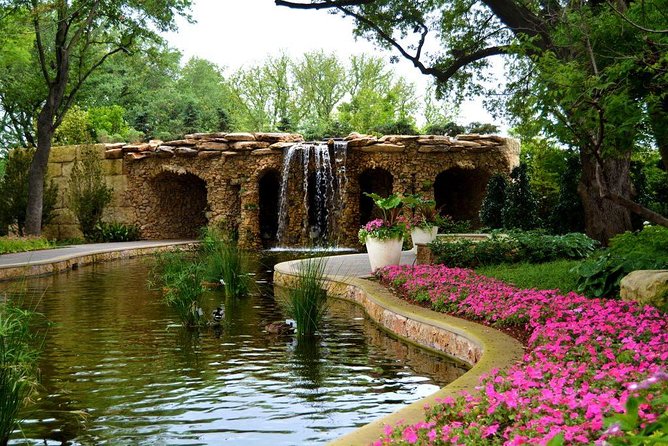
The 2.2-acre Lay Family Garden is built around water. Its features include the Lay Grotto, a waterfall, a koi pond, a lagoon for aquatic plants, a stream with three weirs, and cascading water beneath a trellis.
The native limestone walls and waterfalls give this garden a strong sense of place. It also offers relief on a hot day, particularly when you can pause near the moving water. Families often stop at the koi pond, while the main lawn provides a popular setting for photographs and weddings.
The garden is attractive year-round, but the water features are the real reason to slow down. The 15-minute schedule gives you time for a quick look and a few photos. If koi and fountains are high on your list, this is one of the stops where you may want to request a little extra time.
White Rock Lake views from A Woman’s Garden
A Woman’s Garden combines sculpture, water, and an open view toward White Rock Lake. Its infinity pool and fountains make a strong setting for photographs, while the flowing water also gives children something to watch and enjoy.
This stop is a good reminder that the arboretum is not only about plants. The placement of paths, sculptures, water, and the lake view creates a series of outdoor rooms. You will likely want a few minutes here for photos, especially if the weather is clear.
Because the garden looks across the water, it can feel more open than the enclosed planting areas. Keep that contrast in mind as you move through the tour. The visit works best when you notice the changes in scale and mood, not just the flowers.
Walking beneath Crape Myrtle Allee
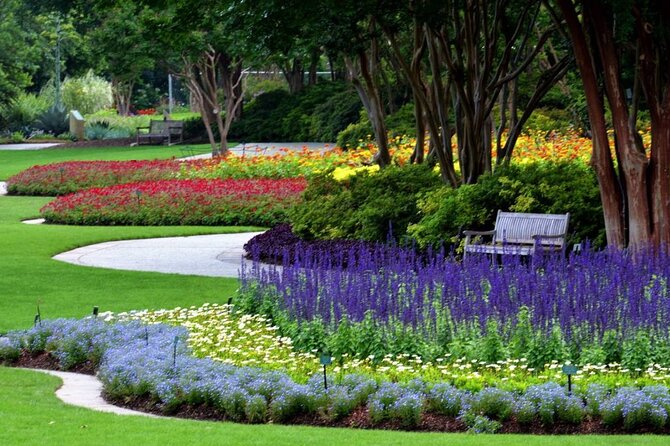
Crape Myrtle Allee forms a natural tunnel over a stone walkway leading toward Toad Corners. The trees change character with the seasons. Late spring through summer brings foliage and flowers, while fall and winter offer a simpler, more sculptural view.
The Allee is paved with Pennsylvania bluestone and includes a newer lane of crape myrtles that replaced the original trees planted by the DeGolyer family. It is also a favorite location for family and engagement photographs.
Toad Corners Fountain adds a playful note near the end of the path. Vendors sometimes set up tables in the fall, winter, and spring, but those appearances are seasonal and not assured. This is a pleasant stretch for walking, though the limited time means you may pass through rather than sit and linger.
Seasonal color at the Jonsson Color Garden

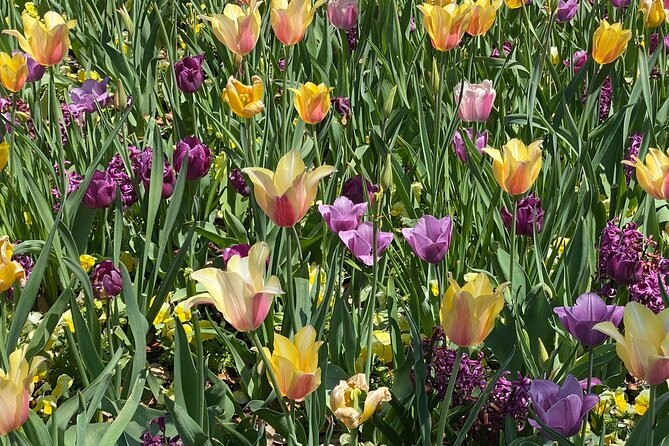
The Jonsson Color Garden is one of the most season-dependent sections. In spring, more than 2,000 varieties of azaleas share the display with daffodils and tulips. Summer brings banana and tapioca plants, while autumn shifts toward chrysanthemums.
The garden also includes a Waterwise display created to show how a low-water garden can be installed and managed. That is a practical touch in a region where heat and water use matter. Home gardeners may get more from this section than from a purely decorative flower bed.
Within the Color Garden, the Eugenia Leftwich Palmer Fern Dell provides shade, mature trees, camellias, azaleas, and more than 90 types of ferns. Fine mist regularly cools the area, making it roughly 10 degrees cooler than the rest of Dallas according to the garden’s description.
I would save a little energy for Fern Dell, particularly in late spring or summer. The brook, shady paths, benches, and hidden art make it one of the calmest sections on the route.
DeGolyer Gardens and the 21,000-square-foot house
The DeGolyer Gardens surround the 21,000-square-foot DeGolyer House, a major historic feature of the arboretum. The home is listed on both the National Register of Historic Places and the Texas Register of Historic Places, and it is open daily for tours.
The gardens were designed in 1940 by Arthur and Marie Berger for the DeGolyer family. Original elements include Magnolia Allee, the Sunken Garden, and the Octagonal Fountain. The entry planting was redesigned in 2012 with hardy tropical plants and palms.
The house and gardens add historical depth to the visit. You are not simply looking at modern plant beds. You are also seeing an estate setting that has been adapted into a public garden.
January and February can be particularly good months for photographs here, when daffodils brighten the view. If you visit at another time, the fountain, lawn, and formal layout still give the stop plenty of interest.
Quiet corners: McCasland Sunken Garden and the Rose Garden
The McCasland Sunken Garden has a more intimate feel. Its staircase, small lawn, courtyard, benches, and fountain create a quiet setting around the Chico y Chica de la Playa sculpture. It is used for weddings and private events, but it also works as a peaceful place to sit.
Spring and summer bring the fullest growth, while the afternoon shade and cooling fountain can make the garden comfortable in warmer weather. This is another stop where a private guide can help you balance photographs with a short pause.
The Rose Garden is smaller and more focused. It contains more than 200 Hybrid Tea Roses in 16 varieties. October is usually the peak rose season, depending on weather, though the garden remains green and shaded during much of the year.
If roses are your main reason for booking, plan around October rather than assuming every month will offer peak blooms. A garden this large always has something in season, but no single section looks the same year-round.
Japanese maples at Red Maple Rill
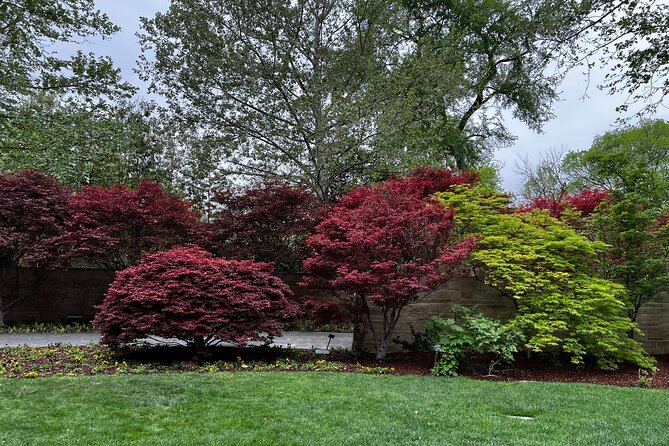
The Nancy Rutchik Red Maple Rill is a two-acre garden built around a stream and more than 80 varieties of Japanese maples. Paved paths, a stone bridge, and the Martin Rutchik Concert Stage connect this area with Magnolia Allee.
The best way to experience it is slowly, listening to the stream and looking up into the different maple forms. A nearly 100-year-old weeping Japanese maple anchors the garden and gives it a sense of age that newer plantings cannot match.
Fall should be especially appealing here, although the supplied details do not promise a specific peak date. Give yourself time to cross the bridge and follow the stream rather than treating this as another quick photo stop.
A Tasteful Place and the value of the final stretch
A Tasteful Place is a 3.5-acre potager garden with a pavilion and kitchen. It focuses on growing and eating fresh, sustainable, locally grown food. Daily free tastings and seasonal displays are part of the experience, and the area has views of the Dallas skyline over White Rock Lake.
This section broadens the tour beyond ornamental gardening. You can see how food production, design, education, and public enjoyment fit together in one space. Since the tour is only about three hours, ask your guide where A Tasteful Place fits into the route and how much time is available there.
The garden’s many sections are a strength, but they also create the tour’s main limitation. The listed stops often allow about 15 minutes each, and the full route includes more than a dozen areas. That is enough for an overview, but not enough for a detailed visit to every house, fountain, research bed, and side path.
Price, pickup, and practical value
The cost is $215 per person for about three hours. That is a serious price for a garden visit, especially for a solo visitor or couple who are comfortable arranging their own transport and buying regular admission.
The value improves if you want a private guide, private vehicle, and door-to-door convenience. Admission is included, and transportation is in a luxury air-conditioned SUV. Pickup is offered for some downtown and Uptown Dallas hotels, but the supplied details give two different limits: properties within three miles of 100 S Houston Street, and hotels within a two-mile radius of downtown. Confirm your exact pickup location before paying.
Otherwise, the meeting point is 47 Highland Park Village Shopping Center at the southwest corner of Preston Road and Mockingbird Lane. The activity returns to that meeting point.
This is a private activity, not a shared group tour. Most people can participate, and a mobile ticket is provided. The tour is offered in English. The experience requires good weather, and the stated cancellation policy is strict: it is non-refundable and cannot be changed, though a weather cancellation offers a different date or a full refund.
Who should book this private visit
I would choose this tour if you have limited time in Dallas, want a guide to explain the plantings and garden design, or prefer not to handle transportation. It also suits couples, families, and small groups who want the route shaped around their interests.
It is less appealing if you want hours of quiet wandering, plan to focus on one garden section, or are mainly looking for the lowest-cost way into the arboretum. The private format gives you flexibility, but the three-hour schedule still asks you to keep moving.
FAQ
How long does the Dallas Arboretum tour last?
The tour lasts approximately three hours.
Is admission to the Dallas Arboretum included?
Yes. The entrance ticket is included in the tour price.
Is this a private tour?
Yes. Only your group participates in the activity.
Is hotel pickup available?
Pickup is offered for some downtown and Uptown Dallas hotels. The supplied details describe a two-mile downtown radius and also properties within three miles of 100 S Houston Street, so confirm your hotel’s eligibility before booking.
Where does the tour depart if pickup is not available?
The meeting point is 47 Highland Park Village Shopping Center in Dallas, at the southwest corner of Preston Road and Mockingbird Lane.
What transportation is provided?
Transportation is provided in a luxury air-conditioned SUV.
What happens if bad weather cancels the tour?
You will be offered a different date or a full refund if the tour is canceled because of poor weather.
Should you book it?
Book this tour if personal guiding, private transport, and a broad overview matter more to you than a low admission price. Rebecca’s reported Highland Park commentary shows how the return drive can add local context beyond the garden itself.
I would be cautious about booking it solely for peak blooms unless you can match your date to the season. Dallas Blooms may have already peaked by the time you arrive, while roses are most likely to impress around October and daffodils brighten DeGolyer Gardens in January and February.
For a first look at the arboretum, this is an efficient and comfortable choice. Just accept that the itinerary moves quickly, and tell your guide which two or three areas matter most before the walking begins.
Just added around the USA
- Zen Garden Yoga Bliss Experience★ 5.0 · 2 reviews
- Tulip Festival in Skagit Valley Tour from Seattle★ 4.5 · 28 reviews
- Tulip Festival and Skagit Valley Tour★ 5.0 · 7 reviews
- Midnight in the Garden of Good and Evil Walking Tour★ 5.0 · 65 reviews
- Tulip Festival at Skagit Valley ,La Conner and Deception Pass★ 4.0 · 4 reviews
- Skagit Valley Tulip Festival Day Tour from Seattle★ 4.5 · 7 reviews
- Botanical Tour (by Walk With Me Savannah Tours)★ 5.0 · 43 reviews
- A Walk Through The Book “Midnight in the Garden of Good and Evil”★ 4.0 · 52 reviews
USA Garden Tours, compared.
Princeville Botanical Gardens Tour and Chocolate Tasting Ticket
Read our review →
South Maui: Snorkel to Coral Gardens or Molokini Crater
Read our review →

Everglades: Mangrove Maze Airboat Tour and Boardwalk
Read our review →
Maui Afternoon Snorkel Aboard Malolo to Molokini or Coral Gardens
Read our review →
Big Island Waterfalls Tour with Swimming and Botanical Garden
Read our review →
Hilo Shore Excursion: Active Volcano, Lava Tube, Waterfall and Gardens
Read our review →
Browse the lists this tour appears in